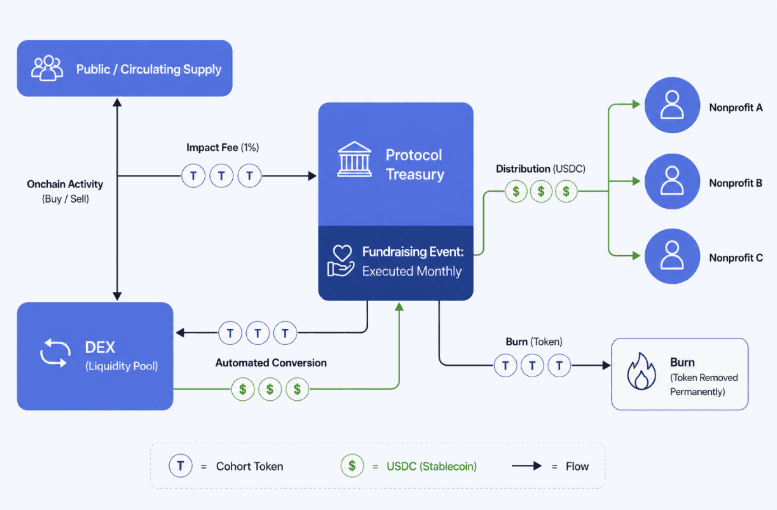
Designed to operate automatically once a cohort launches, onchain activity generates Impact Fees that accumulate inside the Protocol Treasury. Monthly fundraising events then convert a portion into USDC for participating nonprofits.
How the Protocol Works
The Impact Protocol follows a simple cycle from cohort launch through nonprofit distribution. Hover over any card to see the deeper explanation.
01 — Cohort Launch
A cohort launches under predefined rules.
Each EvolveNP cohort begins with its core rules, nonprofit recipients, distribution rules, and launch protections established before deployment. Once deployed, those rules remain immutable and enforced by the protocol.
02 — Onchain Activity
Cohort token trades generate Impact Fees.
The Impact Fee is tied to the Treasury’s size. When the Treasury is below 30% of supply, each buy and sell includes a 1% fee routed into the Treasury. At 30%, the fee turns off until the Treasury falls below the cap again.
03 — Treasury
Impact Fees accumulate inside the Protocol Treasury.
The Protocol Treasury is a smart-contract-controlled part of each cohort, not a wallet managed by EvolveNP or participating nonprofits. Under normal conditions, it operates immutably according to the rules set at deployment.
The Treasury is infrastructure, not a managed fund.
04 — Fundraising Event
A monthly fundraising event converts cohort tokens into USDC for participating nonprofits.
During the fourth week of every month, a seven-day Fundraising Event Window opens. One event occurs at a randomized time, converting 2% of the Treasury into USDC and burning a separate 2% according to the protocol’s rules.
05 — Nonprofit Distribution
USDC is routed directly to participating nonprofits.
After conversion, USDC is automatically distributed to the cohort’s three participating nonprofits according to predefined splits. Each nonprofit receives funds directly into its own wallet, and EvolveNP never takes custody.
Built Into Every Step
The Impact Protocol is designed around a small set of principles that apply from cohort launch through nonprofit distribution.
01
Automatic
Core protocol actions occur automatically according to predefined conditions.
Once a cohort launches, actions such as Impact Fee collection, Treasury limits, monthly fundraising events, USDC distribution, and token burns are executed according to the conditions built into the protocol.
EvolveNP does not need to manually collect fees, initiate distributions, determine when funds should move, or approve each fundraising event.
Why it matters
A recurring funding mechanism should not depend on someone remembering to operate it each month. Automation reduces reliance on an individual company, employee, or nonprofit to keep the system functioning according to the rules established at launch.
02
Transparent
Protocol activity, Treasury movement, and nonprofit distributions can be observed onchain.
Impact Fees entering the Protocol Treasury, fundraising events, token conversions, burns, and USDC distributions all create public blockchain records.
As cohorts operate, users can verify what occurred, when it occurred, how much moved, and which nonprofit wallets received the resulting USDC.
Why it matters
Transparency should mean more than publishing reports about what happened. The protocol is designed so that its core activity can be independently verified from the underlying onchain records rather than requiring users or participating nonprofits to rely solely on EvolveNP's reporting.
03
Immutable
Core economic and distribution rules are designed to remain fixed after deployment.
The economic rules governing Impact Fees, Treasury behavior, fundraising events, burns, nonprofit beneficiaries, and distribution routing are established before launch and remain immutable under normal operating conditions.
The protocol's narrowly limited break-glass mechanism does not provide general authority to rewrite these rules. It exists only to repair a specific external integration if predefined emergency conditions indicate that integration has become compromised or unusable.
Why it matters
If the rules governing a cohort could be freely changed after people began interacting with it, the protocol would ultimately depend on whoever retained that authority. Immutability makes the deployed rules the operating rules rather than leaving core economic or distribution decisions subject to future discretion.
04
Non-Custodial
EvolveNP does not have general authority to withdraw or redirect protocol assets.
Neither EvolveNP nor participating nonprofits can directly withdraw assets from the Protocol Treasury.
During a fundraising event, the protocol converts cohort tokens into USDC and routes each nonprofit's predefined share directly to a wallet controlled by that nonprofit. The distribution does not pass through an EvolveNP-controlled wallet.
Why it matters
The protocol is intended to provide infrastructure for nonprofit funding, not create another intermediary that must receive, hold, and redistribute the money. Keeping custody with the protocol during execution and with nonprofits after distribution reduces the amount of discretionary control EvolveNP has over the movement of funds.
05
Rules-Based
The protocol executes according to predefined conditions rather than discretionary decisions.
The protocol defines in advance when the Impact Fee applies, how large it is, how much the Treasury can accumulate, when the Fundraising Event Window opens, what conditions must be satisfied before execution, how much is converted and burned, and where resulting USDC is distributed.
Those rules apply consistently rather than being determined separately for each transaction, fundraising event, or nonprofit distribution.
Why it matters
Automation alone does not eliminate discretion if someone can continuously change the rules being automated. A rules-based system defines both the action and the conditions governing that action before deployment, making protocol behavior more predictable and reducing reliance on ongoing subjective decisions.
Protocol Architecture
Under the Hood
The Impact Protocol is made up of specialized smart contracts, each responsible for a specific part of the system.
Core Contracts
Safeguards
Core Contract
Treasury Distribution Vault
Holds the Cohort Tokens collected through the Impact Fee and executes the protocol’s predefined fundraising-event rules.
What It Does
Converts the designated Treasury portion to USDC, distributes it to verified nonprofits, and burns an equal portion of tokens.
What It Cannot Do
No person or organization can manually withdraw, redirect, or sell the Treasury’s assets.
Assets move only when the conditions built into the protocol are satisfied.
Plain Language
Glossary
A simple guide to the terms used throughout the Impact Protocol.
Cohort+
A cause-based ecosystem that connects one Cohort Token with a defined group of verified nonprofit partners.
Cohort Token+
The token associated with a specific cohort. Its supported onchain trading activity powers that cohort’s funding mechanism.
Impact Fee+
The 1% fee collected in Cohort Tokens from eligible buys and sells and routed automatically to the Protocol Treasury.
Protocol Treasury+
The non-custodial smart contract that holds collected Cohort Tokens until the protocol’s fundraising-event conditions are met.
Treasury Cap+
The maximum share of the Cohort Token supply the Treasury may hold. The Impact Fee pauses at the 30% cap.
Fundraising Event+
The recurring protocol event that converts 2% of Treasury holdings to USDC for nonprofits and burns an equal 2%.
USDC+
A digital dollar designed to maintain a value of one U.S. dollar. Nonprofits receive distributions in USDC.
Token Burn+
The permanent removal of Cohort Tokens from supply. Burned tokens cannot be traded, transferred, or returned to circulation.
Non-Custodial+
No person or organization holds or controls the Treasury’s assets. Tokens move only through the protocol’s rules.
Immutable+
Unable to be changed after deployment. Core rules, beneficiaries, and distribution splits are fixed at cohort launch.